

Many Israelis believe Israel’s territorial gains resulted from defensive wars fought to protect the country. Palestinians often see the same events differently. They argue that the Nakba, the Six-Day War, settlement expansion, and the destruction and displacement in Gaza are not isolated incidents, but part of a broader pattern in which wars and security threats became opportunities to acquire more territory and displace more Palestinians.
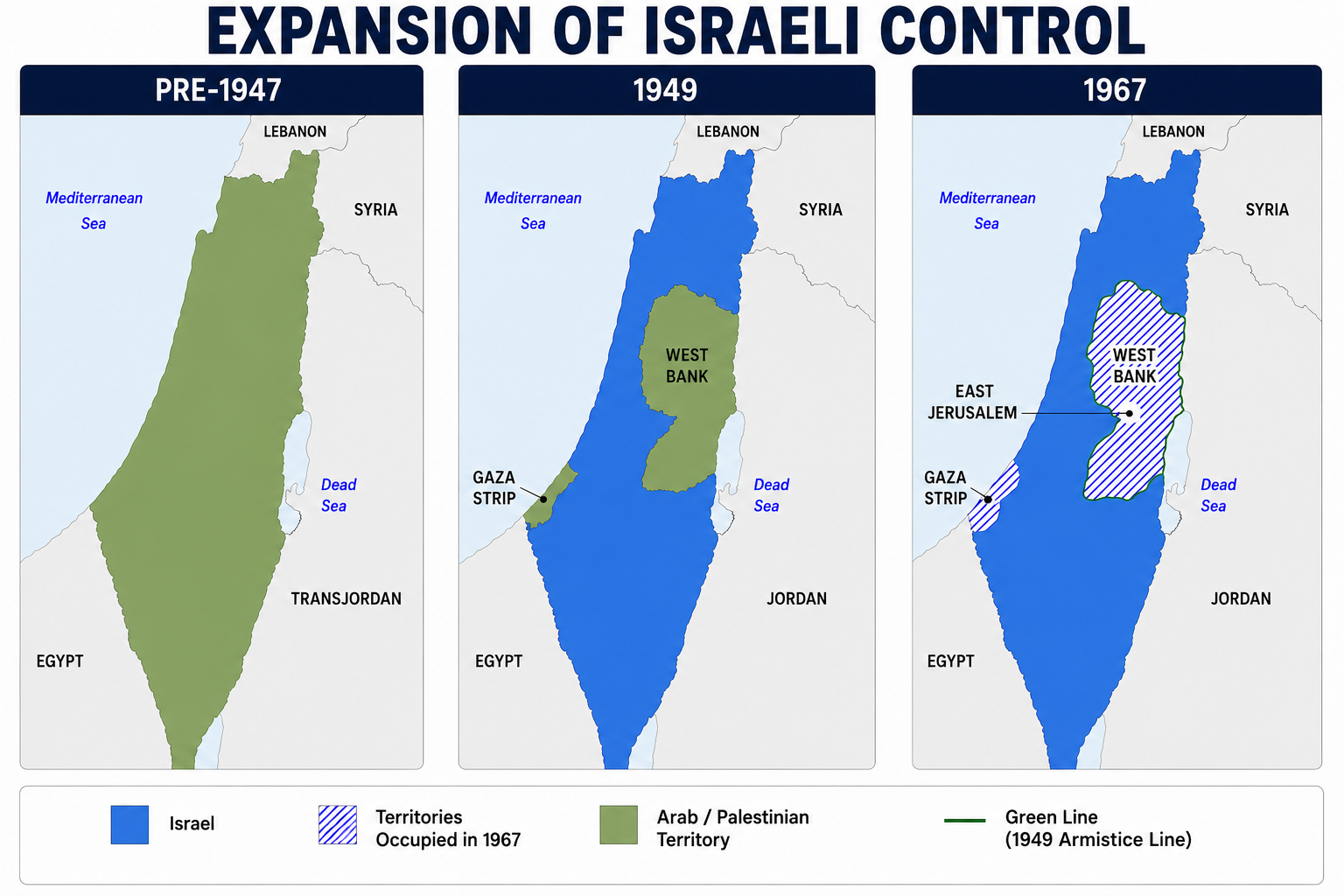
The accompanying map highlights key moments in the history of the region, from the period before the United Nations partition plan (Pre-1947), to the aftermath of the Nakba (1949), and the territorial changes that followed the Six-Day War (1967).
Consider each event. When viewed together, do these changes represent a series of unrelated events, or do they reveal a broader pattern of expanding Israeli control over territory while displacing Palestinians? If so, whether this process ends with control of historic Palestine or extends toward the larger territory associated with the Promised Land remains uncertain.
For Christians, these events raise a deeper question. If the pattern described by Palestinians is correct, and the expansion of Israeli control has come through repeated wars, displacement, military occupation, and settlement growth, would Jesus support that process? Or would He instead call us to pursue a more righteous path toward a just and lasting peace that protects both Israeli security and Palestinian rights and dignity?
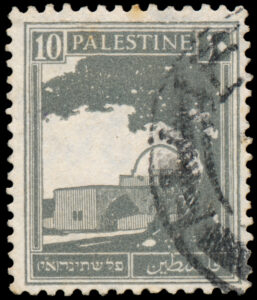 In 1947, the United Nations proposed partitioning Palestine into separate Jewish and Arab states. The Jewish leadership accepted the plan, while Arab leaders rejected it. Many Palestinians viewed the proposal as fundamentally unfair because Jews made up roughly one-third of the population, many of whom had arrived in recent decades, owned a small percentage of the land, and were allocated approximately 55% of Palestine under the partition plan.
On May 14, 1948, Israel declared itself a state. After centuries of persecution and the Holocaust, the creation of Israel represented the establishment of a Jewish homeland. From this perspective, Israel fought a defensive war for survival against neighboring states that sought to destroy the newly declared country.
Palestinians remember 1948 differently. A couple of months before Israel declared itself a state in May 1948, pre-Israeli paramilitary groups attacked hundreds of Palestinian villages under an initiative called “Plan Dalet” (Plan D). The purpose of Plan Dalet was not only to secure the areas allocated to the Jewish state, but also to take control of as much Palestinian land as possible. They killed thousands of Palestinians and expelled hundreds of thousands more.[1]
One of the most publicized massacres during this period occurred in Deir Yassin on April 9, 1948, a village about four miles west of Jerusalem. The pre-Israeli paramilitary groups killed approximately 250 villagers, according to varying historical estimates.[2] News of the massacre spread rapidly through neighboring Palestinian communities and contributed to widespread fear and displacement. [1]
Hundreds of thousands of Palestinians fled their homes into neighboring countries, creating a humanitarian and political crisis. The surrounding Arab countries then attacked Israel, despite being disorganized, poorly equipped, and undermanned.
In the end, Israeli forces captured 78% of Palestine, significantly more than the 55% allocated under the United Nations partition plan. Around 700,000 Palestinians fled for their lives or were expelled, leaving everything behind. Their villages were later destroyed.[1]
Sources
[1] Charles Smith, Palestine and the Arab-Israeli Conflict (10th Edition), pp192-204
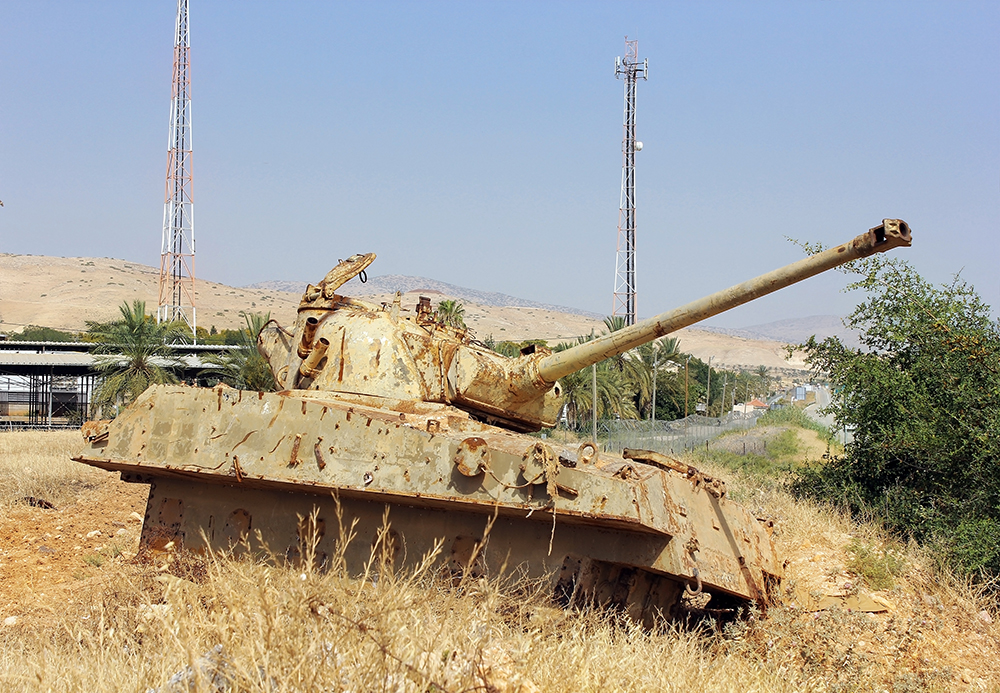 In 1967, Israel launched what many would describe as a preemptive strike against Egypt, beginning the Six-Day War. The conflict quickly expanded to include Jordan and Syria. By the end of the war, Israel controlled East Jerusalem, the West Bank, and the Gaza Strip.
Many Israelis view the war as a defensive war fought for national survival. They point to the mobilization of Arab armies, threats against Israel, and the closure of the Straits of Tiran. From this perspective, the territories captured during the war were gained through self-defense rather than conquest.
Palestinians focus on a different consequence of the war. An additional 100,000 Palestinians fled or were expelled from their homes. After the war, the Israeli government demolished many homes and villages, preventing their former residents from returning.[1]
Many Palestinians believe Israel used the war not only to address security concerns, but also to acquire additional territory and further displace the Palestinian population. They argue that self-defense does not require capturing and retaining territory while continuing a process of displacement that began in 1948.
Sources
[1] Charles Smith, Palestine and the Arab-Israeli Conflict (10th Edition), p289
Since the Six-Day War, Palestinians in the West Bank and East Jerusalem have experienced a gradual process of land confiscation, home demolitions, displacement, and settlement expansion. Unlike the Nakba and the Six-Day War, which unfolded rapidly and drew global attention, this process has unfolded over decades. Today, approximately 700,000 Israeli settlers live in East Jerusalem and the West Bank.[1] The growth of settlements, roads, security zones, and other restrictions has created a complex patchwork of Israeli and Palestinian-controlled territory.
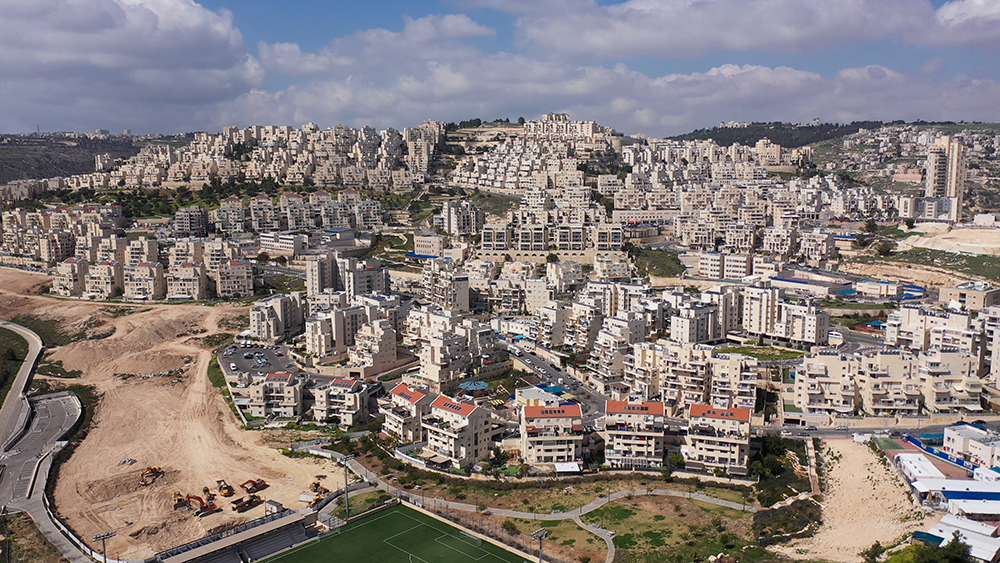 Many Israelis reject the idea that they are occupying Palestinian land. They believe the land belongs to the Jewish people and view the West Bank as part of their historic homeland. If it is their land, how could they be illegally occupying it? From this perspective, Jewish communities built there are not settlements in a foreign country, but Israelis living in their own land. They also argue that restrictions on Palestinians and a continued Israeli presence are necessary to protect Israeli citizens from terrorism and other security threats.
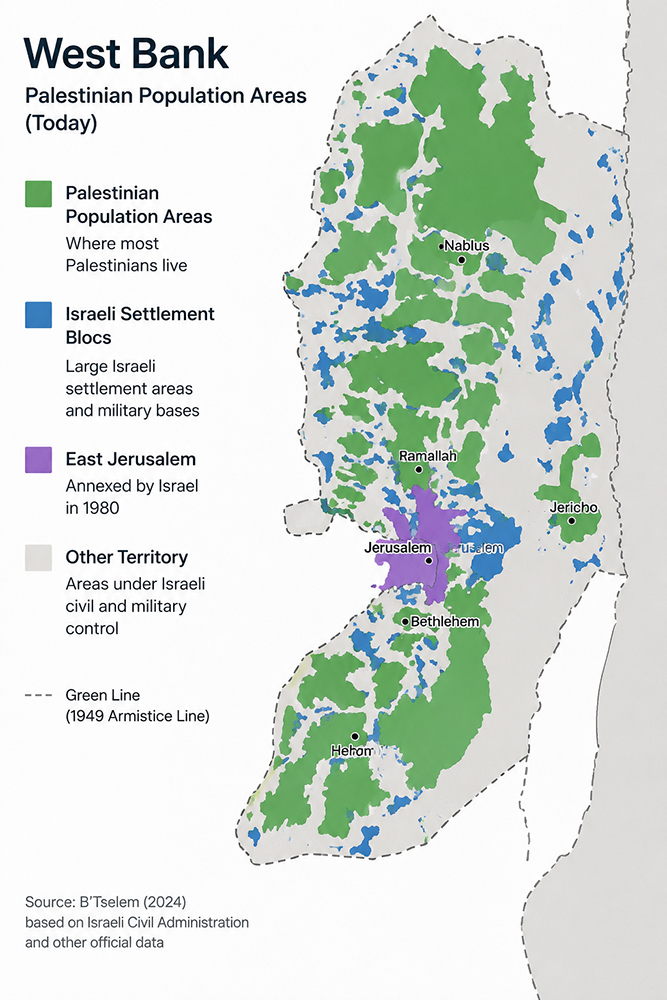
Palestinians see it differently. They argue that ownership is not the only issue. For centuries, the land was governed by the Ottoman Empire, the British, and later by Jordan and Egypt. But unlike previous rulers, they argue that the Israeli government uses military control to confiscate land, demolish homes, and continually expand settlements. To them, the question is not only who claims the land, but whether one people should rule another for generations while gradually taking homes and farms that have belonged to Palestinian families for centuries.
The accompanying map illustrates the modern geography of the West Bank, including Israeli settlements and the fragmentation of Palestinian-controlled areas. Critics argue that these developments have made the creation of a contiguous Palestinian state increasingly difficult, while supporters contend that the settlements are necessary for Israel’s security and historical claims.
Two Sets of Rules
Over decades of military control, the Israeli government developed a system for governing the Palestinian population in the occupied territories. Several major organizations and public figures have argued that this system meets the definition of apartheid, including Human Rights Watch [2], Amnesty International [3], the Israeli human rights organization B’Tselem[4], and former U.S. President Jimmy Carter.[5] A 2021 Jewish Telegraph Agency survey found that approximately one-quarter of American Jews believed Israel was committing apartheid.[6]
Many Israelis and their supporters reject the apartheid label. They point out that Palestinian citizens of Israel can vote, serve in the Knesset, and participate in Israeli public life. That is true for Palestinians living within Israel’s internationally recognized borders. However, Palestinians living in East Jerusalem, the West Bank, and Gaza experience a very different reality under decades of Israeli military control.
Under international law, apartheid refers to systematic oppression and domination by one racial group over another. Organizations and individuals who argue that the system meets this definition point to several factors in the Palestinian territories:
- Israeli settlers living in the Palestinian territories vote in Israeli elections while Palestinians do not.
- Israeli settlers are governed by Israeli civil law while Palestinians are governed by military law.
- Palestinians may be held under administrative detention without formal charges or trial.[7]
- Palestinians face hundreds of movement restrictions, checkpoints, and road barriers.[8]
- Palestinian homes and land are frequently confiscated for settlement expansion.
- Palestinians are divided into numerous disconnected enclaves throughout the West Bank.
Based on these and other factors, major human rights organizations argue that the system meets the legal definition of apartheid. Israeli officials and many of Israel’s supporters strongly reject that characterization, arguing that the measures are driven by security concerns rather than racial domination. Readers must decide for themselves whether the comparison is justified.
Sources
[1] OHCHR, Israeli settlements in the occupied Palestinian territory
[2] Human Rights Watch, A Threshold Crossed
[3] Amnesty International. Israel’s Apartheid Against Palestinians
[5] Jimmy Carter, Palestine: Peace Not Apartheid
[6] Jewish Telegraphic Agency, “Survey: A quarter of US Jews agree that Israel ‘is an apartheid state:”
[7] B’Tselem, Administrative Detention
[8] OCHA, Fact Sheet: Movement and Access in the West Bank, August 2023
In 2005, the Israeli government withdrew its settlers and relocated its military presence from inside the Gaza Strip to positions surrounding it. It continued to control Gaza’s airspace, maritime access, the flow of goods, and most border crossings. Movement into and out of the territory remained heavily restricted.[1]
On October 7, 2023, Hamas launched a surprise attack that killed approximately 1,200 Israelis and resulted in the capture of hundreds of hostages. The Israeli government responded with a large-scale military campaign involving extensive aerial bombardment and a ground invasion. According to the Euro-Med Human Rights Monitor, more than 70,000 Palestinians had been killed.[2]
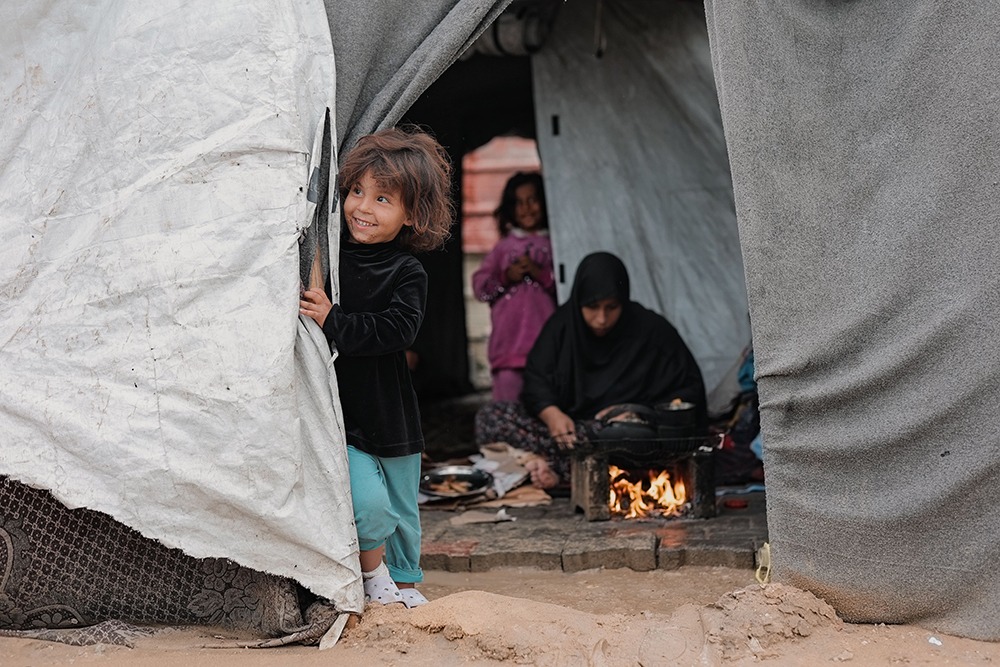
Today, the Israeli government exercises military control throughout Gaza. Approximately 99% of Gaza’s population has been displaced and now lives in tents on a shrinking fraction of the Gaza Strip.[2]
Many Palestinians argue that while Israel had a right to respond to the October 7 attacks, self-defense does not justify the destruction of Gaza, the displacement of nearly its entire population, and the continued military control of the territory. They believe Israel took advantage of the attacks to expand its control and further displace Palestinians while laying the groundwork for new settlements in Gaza.
Sources
[1] United Nations, The Question of Palestine – Gaza Strip Fast Facts
[2] Euro-Med Human Rights Monitor, 100 Days Into the Ceasefire: Genocide Continues in Gaza