

Shortly after the 9/11 attacks, retired General Wesley Clark said he heard of a Pentagon memo describing plans to
“take out seven countries in five years, starting with Iraq, and then Syria, Lebanon, Libya, Somalia, Sudan, and finishing off Iran.”[1]
Several years earlier, a group of American and Israeli policy advisors produced a report titled A Clean Break: A New Strategy for Securing the Realm. The report argued for a stronger Israel and identified Iraq, Syria, Iran, and Hezbollah in Lebanon as major obstacles to Israel’s long-term security.[2]
The overlap is notable. Over the following decades, Iraq, Syria, Lebanon, Libya, and Iran faced sanctions, regime-change efforts, or military operations by the United States, Israel, or both.
In an interview, former Defense Department official Dennis Fritz, who served in military intelligence under senior Pentagon leadership, said,
“Going into Iraq was part of the master plan to take out Saddam, to take out Assad in Syria, and to take out the Ayatollah in Iran. … It was on behalf of Israel…. If Hezbollah and Hamas did not have that funding and weapons provided by those countries, there would be no way that the Palestinians could defend themselves.”[3]
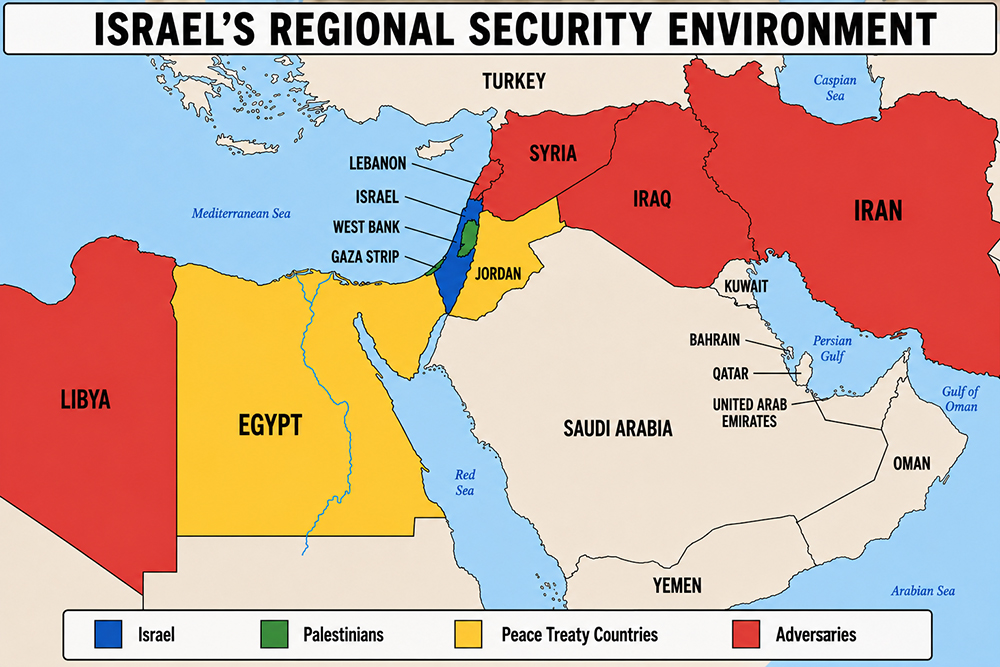
Each country, in one form or another, supported the Palestinian cause, but none were responsible for the 9/11 attacks or posed a direct threat to the American homeland. The cumulative effect was the weakening of many of the strongest supporters of the Palestinian cause and a significant shift in the regional balance of power favoring Israel.
The map shown illustrates the regional landscape that emerged over the past several decades. Several countries identified as threats to Israel’s security later became targets of sanctions, military intervention, regime-change efforts, or diplomatic isolation.
By contrast, countries that normalized relations with Israel through peace agreements received substantial American military and economic assistance. Egypt and Jordan alone have received tens of billions of dollars in U.S. aid since signing peace treaties with Israel.[4]
Whether this pattern of fighting Israel’s enemies while financially rewarding countries that made peace with Israel reflects strategic necessity or is simply a coincidence remains a matter of debate.
For Christians, another question follows naturally. If peace with the Palestinians existed, would many of these wars still be necessary? As we examine the historical record, we should also ask: Would Jesus support this path?
Sources
[1] Democracy Now, “Gen. Wesley Clark – Democracy Now [2007]”
[2] A Clean Break Report: A New Strategy for Securing the Realm (1996)
[3] Judge Napolitano, “Why the US Invaded Afghanistan and Iran”, Time Stamp 10:30-11:45
[4] Al Jazeera, “Egypt. Jordan, and the US aid game”
 Under Saddam Hussein, Iraq presented itself as a supporter of the Palestinian cause. The Iraqi government provided financial assistance to the families of Palestinians killed or imprisoned during the Israeli-Palestinian conflict.[1] While Iraq supported Palestinian groups hostile to Israel, postwar investigations found no operational alliance between Saddam’s government and Al-Qaeda before the 2003 invasion.
The reasons for the Iraq War remain heavily disputed. The Bush administration claimed that Iraq possessed weapons of mass destruction and maintained ambitions for nuclear weapons. Some officials also suggested possible links between Iraq and Al-Qaeda, the organization responsible for the 9/11 attacks. However, after the invasion, no weapons of mass destruction were found, and investigations concluded that Saddam Hussein’s government had no operational role in the 9/11 attacks and was not considered an imminent threat to the United States.
Critics of the war offer a different explanation. Before the war, Benjamin Netanyahu publicly advocated removing Saddam Hussein’s regime.[2] Paul Wolfowitz, the Deputy Secretary of Defense, reportedly raised the possibility of going to war with Iraq within days of 9/11 despite the lack of evidence connecting Iraq to the attacks.[3]
Some historians and former officials believe the intelligence used to justify the invasion was exaggerated, selectively presented, or manipulated to build public support for a war that many influential figures already favored.
Former Defense Department official Dennis Fritz, who served in military intelligence under senior Pentagon leadership, argued that one of the primary reasons was “to go to war on Israel’s behalf.”[4]
In 2003, the U.S. invaded Iraq and overthrew Saddam Hussein’s government. Although a new Iraqi government emerged, the country was significantly weakened and remains affected by the consequences of the conflict. The removal of Iraq also eliminated one of the strongest Arab states supporting the Palestinian cause.
Sources
[1] BBC, “Palestinians get Saddam funds”
[2] C-SPAN, “Netanyahu argues for pre-emptive action against Iraq, Iran, Libya”
[3] CNN, “Bush’s Brainiest Hawk: Paul Wolfowitz”
[4] Jeffery Sachs, “Conversation with Dennis Fritz, Deadly Betrayal”, Time Stamp 38:45- 41:00

For Israel, Iran represents not only a regional rival but also the principal state sponsor of groups that have most actively resisted Israeli military operations and occupation. Since the 1980s, Iran has provided funding, training, weapons, and political support to Hezbollah, Hamas, and Palestinian Islamic Jihad.[1] Iran was not responsible for the 9/11 attacks and posed no serious threat to the American homeland.
The United States has not been an innocent bystander in its relationship with Iran. In 1953, the U.S. helped overthrow Iran’s democratically elected government and supported the Shah, whose authoritarian rule lasted until the Iranian Revolution of 1979.[2] The United States also supported Iraq during the Iran-Iraq War in the 1980s.[3]
The Trump administration claimed the reasons for confronting Iran included its nuclear program and support for Hezbollah, Hamas, and other regional militant groups.
Critics point to several facts that raise questions about the nuclear justification for war.
- For decades, Benjamin Netanyahu repeatedly warned that Iran was only months or weeks away from obtaining a nuclear weapon, yet those predictions failed to materialize.[4] After the war began, he stated that this is “what I have yearned to do for 40 years.”[5]
- In 2025, the United States attacked Iranian nuclear facilities and claimed they had been obliterated.
- U.S. intelligence assessments have generally concluded that Iran is not currently building a nuclear weapon.[6][7]
- In 2015, Iran signed the Joint Comprehensive Plan of Action (JCPOA), which imposed strict limits and monitoring requirements on its civilian nuclear program.[8] Netanyahu strongly opposed the agreement and lobbied against it publicly.[9] President Trump later withdrew the United States from the agreement.
If preventing an Iranian nuclear weapon was the overriding objective, critics ask why an agreement specifically designed to restrict Iran’s nuclear program was opposed. They argue that if the JCPOA had remained in effect, concerns about a potential Iranian nuclear weapons program would have been substantially reduced, making it more difficult to justify military action against Iran on the basis of nuclear weapons. They argue that war based on Iran’s support for Hezbollah, Hamas, and other regional militant groups alone would have been more difficult to justify.
Critics also point to the legal rationale offered by the U.S. government itself. State Department Legal Adviser Reed Rubinstein stated that U.S. actions were taken
“at the request of and in the collective self-defense of its Israeli ally, as well as in the exercise of the United States’ own inherent right of self-defense.”[10]
This statement explicitly identifies the defense of Israel as one of the legal bases for U.S. involvement. Supporters of the war argue that concerns about Iran’s nuclear program alone justified military action.
The United States and Israel have confronted Iran in a variety of ways:
- Economic sanctions.
- Cyber operations.
- Assassinations of military and nuclear personnel.
- Diplomatic pressure.
- War and military conflict.
Although Iran has been weakened by these measures, its government remains in power and retains substantial regional influence.
Sources
[1] BBC Monitoring, “Explainer: Iran’s support for Palestinian factions”
[2] Britannica,”1953 coup in Iran | Coup D’etat, Description & Facts”
[4] Al Jazeera, “Benjamin Netanyahu’s 33 years of Iran nuclear warnings”
[5] BBC, “Trump and Netanyahu wanted to reshape the Middle East – now they risk a permacrisis”
[7] PBS: “America’s spies say Iran wasn’t building a nuclear weapon. Trump dismisses that assessment.”
[8] European Parliament, JCPOA
[9] Times of Israel, “Netanyahu calls Iran deal ‘historic mistake for world’”
[10] United States Department of State, “Operation Epic Fury and International Law”
The remaining countries on Clark’s list shared several characteristics. They supported the Palestinian cause and opposed Israeli regional dominance. None posed a direct threat to the American homeland, nor were they responsible for the 9/11 attacks.
Syria

Syria served as a key ally of Iran and Hezbollah and provided support to Palestinian organizations.[1] For decades, Syria was a critical link between Iran, Hezbollah, and Palestinian militant organizations, making it one of the central pillars of the regional alliance opposing Israel.
Beginning in 2011, Syria descended into a devastating civil war. The United States, along with several regional allies, provided varying levels of support to opposition groups seeking to overthrow the Assad government, while imposing extensive economic sanctions. Russia and Iran intervened on Assad’s behalf, turning Syria into the center of a broader regional and international conflict.
Years of civil war, sanctions, foreign intervention, and repeated Israeli military operations left the country devastated and fragmented. Following the collapse of the Syrian government, Israeli forces moved beyond previously established positions and occupied additional territory in southern Syria, where they remain today.
Lebanon
Lebanon was never the primary focus. The target was Hezbollah, a powerful organization backed by Iran and Syria that emerged in response to Israel’s occupation of southern Lebanon.[2] Decades of conflict, sanctions, invasions, and military operations weakened the country and contributed to ongoing instability. Recent fighting has displaced large numbers of people and caused widespread destruction across southern Lebanon.
Libya

Libya under Muammar Gaddafi was a vocal supporter of the Palestinian cause and a frequent critic of both American and Israeli policies in the Middle East.[3] In 2011, the United States and other NATO members intervened militarily in support of forces opposing Gaddafi’s government. The intervention contributed to the collapse of his regime, leaving Libya fragmented and unstable for years afterward.
Each case had its own history and circumstances. Yet the broader pattern is difficult to ignore. Countries and organizations that opposed Israel, supported the Palestinian cause, or aligned themselves with Israel’s regional rivals have repeatedly faced war, sanctions, regime change, military intervention, or sustained pressure involving the United States, Israel, or both. Today, Syria, Lebanon, and Libya are all significantly weaker than they were a generation ago.
Sources
[2] Britannica, “Hezbollah | Meaning, History, Ideology, Iran, Israel, & Flag”